
 By
By 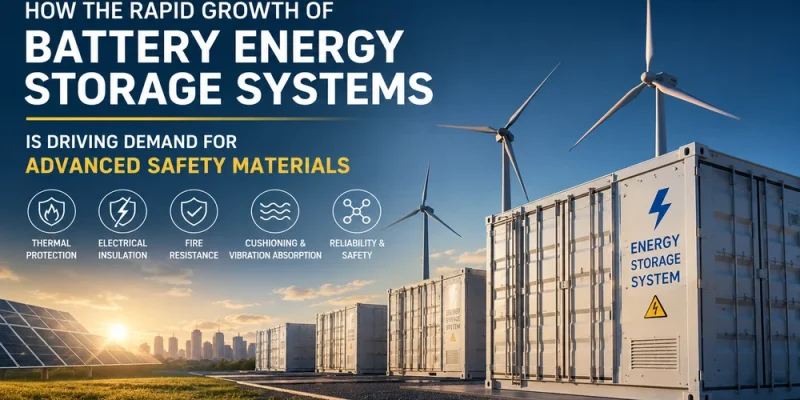
The global transition toward renewable energy is accelerating the deployment of Battery Energy Storage Systems (BESS). From utility-scale solar and wind projects to commercial facilities, microgrids, and residential energy storage, batteries are becoming an essential part of modern energy infrastructure.
However, as battery installations become larger and more energy-dense, safety is becoming an increasingly important engineering consideration. Preventing a single-cell failure from developing into module-level or system-level thermal runaway requires more than battery management software. It also requires carefully engineered thermal insulation, flame-retardant, electrical insulation, cushioning, and fire-resistant materials.
As a result, the rapid growth of the BESS market is creating a parallel market opportunity for advanced battery safety materials.
BESS Expansion Is Changing the Safety Challenge
Lithium-ion batteries dominate today’s energy storage market because they combine relatively high energy density, long cycle life, and increasingly competitive costs. Yet lithium-ion cells contain significant stored energy within compact spaces.
A battery energy storage system may contain thousands-or even tens of thousands-of individual cells arranged into modules, packs, racks, and containers. This concentration of energy changes the nature of battery safety.
The challenge is not simply preventing a cell from failing. Engineers must also consider what happens after a failure begins.
An internal short circuit, manufacturing defect, mechanical damage, electrical abuse, or abnormal temperature condition can potentially trigger thermal runaway. The heat generated by one cell can then affect neighboring cells, creating the possibility of cell-to-cell propagation.
In a large energy storage installation, controlling this propagation is critical. This is driving system designers to adopt a layered safety strategy combining monitoring, cooling, structural design, fire protection, and advanced material solutions.
Safety Materials Are Becoming Part of BESS System Design
Battery safety materials are increasingly designed into multiple levels of the battery architecture rather than being treated as secondary components.
At the cell level, electrical insulation and flame-retardant materials can help isolate individual cells and reduce unwanted electrical or thermal interactions. Materials such as PC insulation flame-retardant sheets can provide electrical insulation while supporting the flame-resistance requirements of compact battery assemblies.
At the module level, thermal propagation becomes a major concern. Materials positioned between cells or around critical components must slow heat transfer while accommodating dimensional tolerances and mechanical movement.
Solutions such as CR foam, nano-silica composite thermal insulation boards, and ceramifiable silicone foam can perform different functions within this environment. Depending on system design, these materials can provide cushioning, thermal insulation, flame resistance, sealing, or high-temperature protection.
At the pack or system level, larger thermal barriers and cushioning structures become important. PIR thermal insulation cushioning boards, for example, can contribute to thermal management and structural protection between battery assemblies and surrounding components.
This multi-level approach reflects an important shift in the market: battery safety is becoming a system engineering problem, and material selection must support safety from the individual cell outward.
Higher Energy Density Creates Demand for Better Thermal Barriers
One of the strongest drivers for advanced safety materials is the industry’s continuous pursuit of higher energy density.
Energy storage developers want more capacity within the same container or installation footprint. Battery manufacturers are therefore developing larger cells, optimized module structures, and increasingly compact system architectures.
But reducing unused space can also reduce the physical distance available to isolate a thermal event.
This creates a difficult engineering balance. Safety materials need to provide effective thermal resistance without occupying excessive space or adding unnecessary weight.
Traditional thick insulation is not always practical. The market is consequently moving toward materials that offer higher thermal protection per unit of thickness, especially in locations between adjacent cells.
Nano-silica-based thermal insulation materials are particularly relevant to this trend because they can help create thin thermal barriers in space-constrained battery modules. As BESS designs continue to become more compact, material performance per millimeter will become an increasingly important selection criterion.
Thermal Runaway Is Increasing Demand for Multi-Functional Materials
Future battery safety materials will increasingly be expected to perform several functions simultaneously.
A material may need to provide thermal insulation while also offering flame resistance, electrical insulation, compression recovery, vibration absorption, or mechanical cushioning. In certain applications, it must maintain these properties after prolonged exposure to temperature fluctuations and compression.
Ceramifiable silicone materials illustrate this trend. Under normal operating conditions, they can provide flexible insulation and cushioning characteristics. When exposed to extreme heat, appropriately designed formulations can form a more stable ceramic-like protective structure, helping maintain a barrier under severe thermal conditions.
This transition from single-function materials to multi-functional safety materials represents an important development opportunity for material manufacturers.
Large-Scale Energy Storage Raises the Value of Reliability
Material reliability becomes even more important as battery installations grow.
A small difference in material performance may appear insignificant at the component level. But when thousands of components are used throughout a large battery storage project, consistency becomes essential.
BESS manufacturers therefore increasingly evaluate not only headline material properties but also long-term performance, dimensional stability, flame-retardant characteristics, compression behavior, temperature resistance, manufacturing consistency, and compatibility with automated assembly processes.
This creates opportunities for suppliers capable of providing both material development and application engineering support.
Instead of simply asking, “What is the thermal conductivity of this material?”, battery manufacturers increasingly need answers to broader questions: How does the material perform after aging? How does it behave under compression? Can thickness and density be customized? Can it be die-cut accurately? Will performance remain consistent across mass production?
These requirements are raising the technical threshold for suppliers entering the battery safety materials market.









Comments