
 By
By 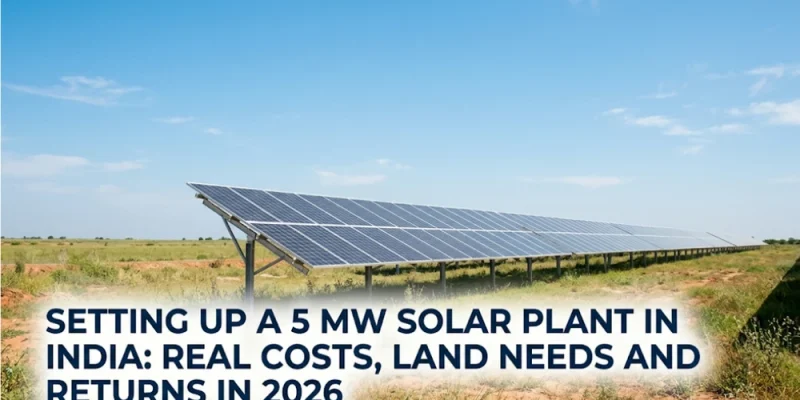
Solar power has moved from being a niche, expensive experiment to one of the most dependable investment options in India’s energy sector. As the country’s cumulative solar capacity crosses 143 GW in 2026, mid-sized installations like a 5 MW plant have become an increasingly attractive choice for investors, industrial buyers, and landowners who want steady, long-term returns without the scale and complexity of a massive utility project.
How a Solar Plant Actually Generates Power
Photovoltaic modules capture solar energy and produce electricity in the form of direct current. Homes, industries, and other power grids require electricity in the form of alternating current; hence, the DC electricity produced by PV modules has to go through a solar inverter. Based on the capacity of the plant, a developer will decide whether a one-phase on-grid inverter is suitable for small-scale plants or a three-phase on-grid inverter is suitable for big plants like a 5 MW solar plant.
Land Requirement for a 5 MW Plant
Old projects used to require approximately 5 acres per MW, while the high-efficiency N-type TOPCon panels currently being used in the ground-mount configuration use just about 4 to 5 acres per MW. That means that a 5 MW solar project would take up approximately 20 to 25 acres of land.
What It Actually Costs in 2026
A turnkey project of a 1 MW solar power plant in India would cost about ₹3.5 to ₹4.5 crore, which is approximately ₹35 to ₹40 per watt. On a larger scale, a 5 MW solar power plant will require about ₹17.5 to ₹22.5 crore in total cost, which includes the cost of panels, inverters, structures, civil works, and grid connection.
The type of panel used has a great impact on the cost. The N-type TOPCon panels, whose cost ranges from ₹14 to ₹18 per watt in India, are more efficient and have less degradation compared to Mono PERC panels that cost ₹12 to ₹16 per watt. There is a premium on DCR panels, which can be about 70% to 100% costlier than non-DCR panels.
Generation and Revenue Potential
Even with a well placed 1 MW plant, it produces 14 – 17 lakh units per annum at a capacity utilization of 17 – 19 percent. For states like Rajasthan & Gujarat where the amount of sunlight is more, the figures would go up to 17-18.5 lakh units per MW per annum.
Considering the above-mentioned scale for a 5 MW plant, the plant will produce an output of 70-85 lakh units per annum with a gross income of ₹4.5 – ₹6 crores. Even after deducting O&M costs of ₹8 – ₹12 lakh per MW per annum, the plant will start showing profits well in eight digits in 4-6 years.
Whereas construction of a complete 5 MW system is done through investors and industry, installation of ground-mounted solar systems at a smaller level is now an actual means of earning money for farmers in the PM-KUSUM scheme. Budget 2026 almost doubled the funding for the scheme, from ₹2,600 crore to ₹5,000 crore, with 10 lakh solar pumps being installed or solarised till date.
A Real Opportunity for Farmers Too, Through PM KUSUM
The scheme consists of three components. In component A, farmers can install ground-mounted plants between 500 kW to 2 MW on wasteland and earn money by selling extra power generated to their DISCOM, which is a mini version of the ground-mounted project described above. Under Component B, stand-alone solar pumps up to 7.5 HP are provided to farmers for off-grid farms with subsidy support of up to 60% of cost, and 80% in northeast and hilly areas. Component C focuses on solarizing existing grid-based pumps.
Whereas, a 5 HP pump installed under Component B would cost the farmer only ₹25,000 to 35,000 out of his own pocket, when the entire system would cost anywhere between ₹1.8 lakh and 3.5 lakh. At the same time, most farmers can recover the full amount in just four months through diesel savings of ₹80,000 to 1,30,000 per year.
The module reliability is equally important as the subsidy because these systems are supposed to survive years of field installation. The ground-mounted modules by Waaree, which include its Mono PERC and bifacial range, are very much capable of cracking resistance, are PID resistant, and suitable for very strong wind and hail loading conditions.
Financing and Tax Benefits Worth Knowing
Even though subsidies for such utilities are very uncommon, the developers have the right to avail themselves of 40 percent accelerated depreciation in the first year and also a concessional GST at 5 percent on renewable energy equipment. Other institutions such as IREDA provide financing for such projects to the tune of 70 to 75 percent of project cost at reasonable interest rates.
Choosing the Right Equipment Partner
For a project of this scale, choosing dependable, well-tested equipment matters just as much as securing land and financing. From the solar panels themselves to the solar inverter systems handling power conversion, reliability directly affects long-term output and maintenance costs. Waaree, India’s largest solar panel manufacturer with over 25.8 GW in manufacturing capacity, supplies both modules and inverter solutions suited to utility-scale projects, backed by decades of manufacturing experience and a service network built to support large installations across the country.








Comments